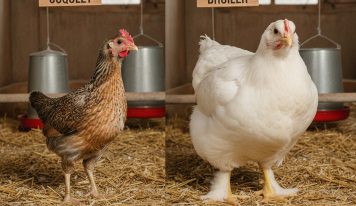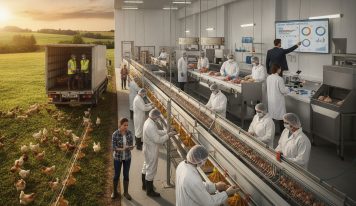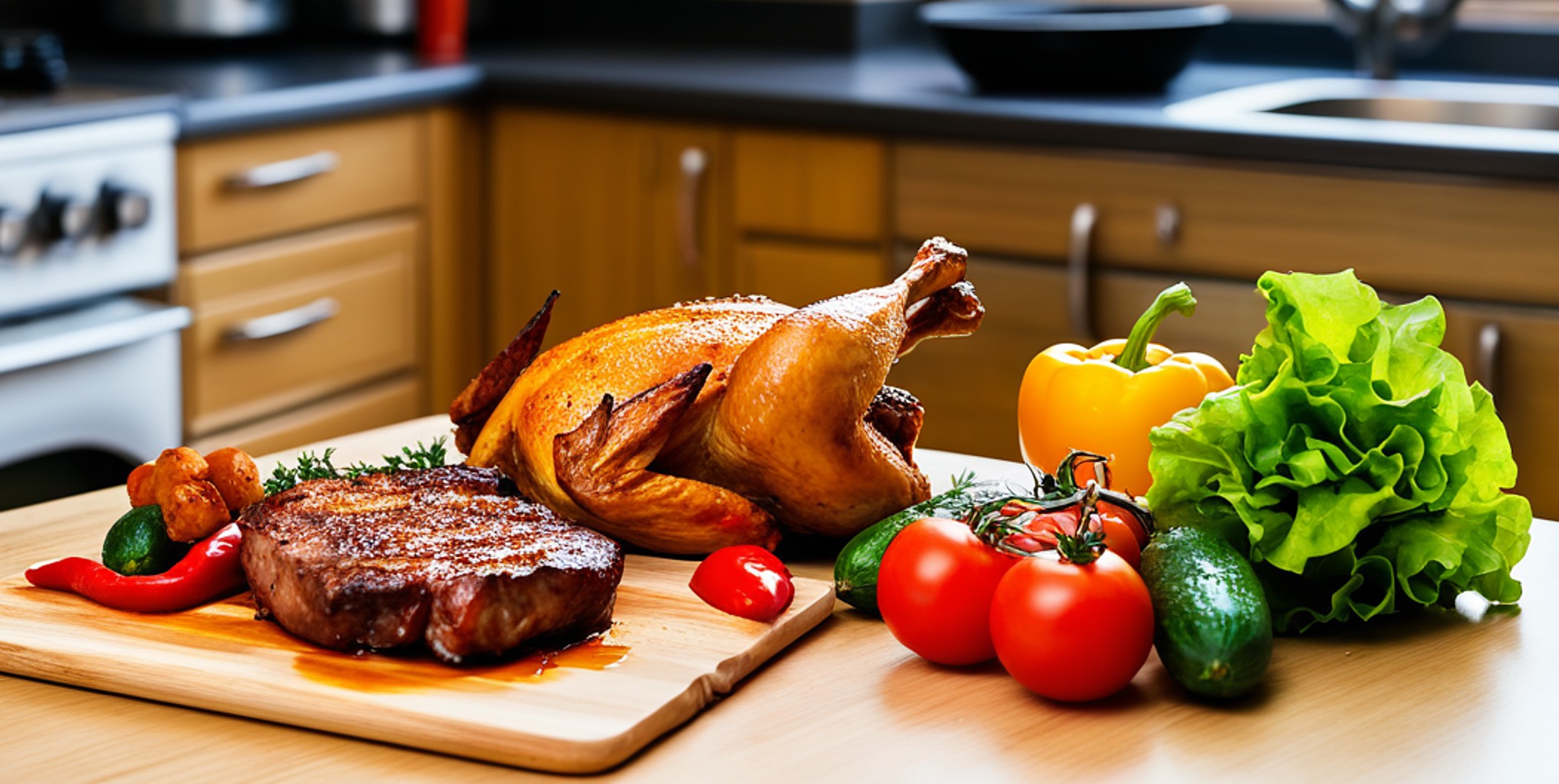
White, red, green… in this article (which we admit is a bit “long,” but also very comprehensive), we first delve into the differences between chicken and red meat, both from a nutritional and environmental impact perspective, then compare them with vegetables (considering both those intended for human consumption and those intended for animal feed) and their environmental impact.
We will also take an in-depth look at the implications of different land uses, and you will see that the differences are significant, especially from an ecological point of view.
The information we provide here is solid and based on “scientific consensus” that we have extensively researched. You can therefore consider it reliable, and we are prepared to defend it on the basis that it refers to a relationship of scale and efficiency of systems and not to individual absolute numbers.
However, we are always open to discussion with accredited, scientifically structured, and recognized organizations in order to make any necessary adjustments to the information provided.
At the end of this article, you will also find a more detailed note on why our content is reliable (the chapter is entitled: “Notes on the reliability of our content”).
Let’s begin:
Comparison of nutritional content
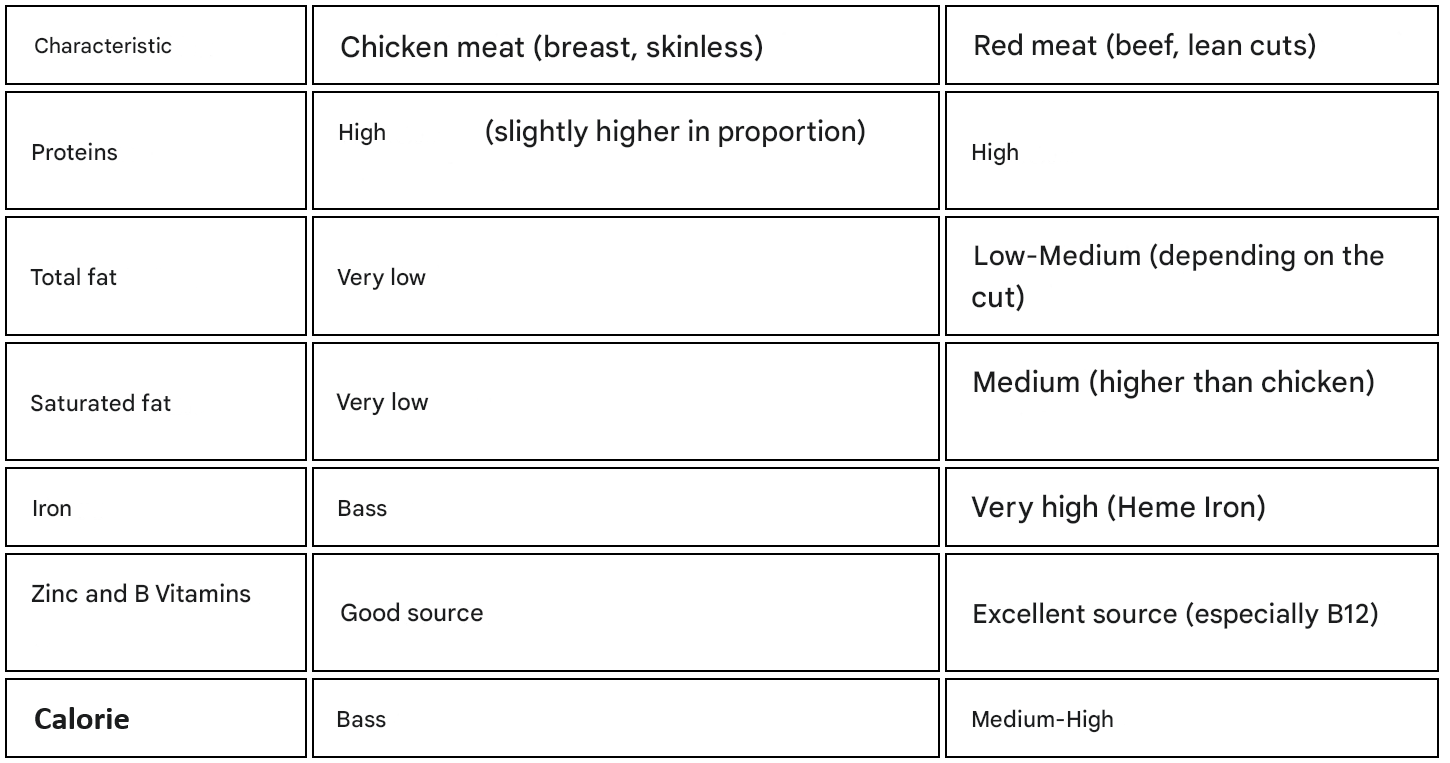
Both types of meat are excellent sources of protein, but they differ significantly in their fat and essential micronutrient content, as summarized in this table:
Key nutritional points
Chicken wins on fat (it is leaner) – Chicken meat (especially skinless breast) is the leanest choice. It contains less total fat and, above all, less saturated fat, making it preferable for cardiovascular health and low-calorie diets.
Red meat wins on iron and B12 content – Red meat is a superior source of heme iron (the form most easily absorbed by the body), zinc, and vitamin B12. These nutrients are crucial for energy production and blood formation, making red meat important for those with deficiencies, such as women of childbearing age.
Comparison of environmental impact
The comparison of environmental impact is clearly in favor of chicken meat. The differences are mainly determined by the biology of the animals and the efficiency of production.
Greenhouse gases (carbon footprint)
The greatest impact is linked to beef production, which is the main source of red meat.
Red meat (beef and lamb)
The carbon footprint is extremely high. This is mainly due to ruminants (cattle and sheep) producing large amounts of methane, a greenhouse gas with a global warming potential many times higher than CO2. Digestion in these animals is the main cause of emissions.
Chicken
The carbon footprint is significantly lower. Chickens are non-ruminant animals, do not produce methane in any significant way, and have a very short life cycle. Emissions are mainly related to feed production and farm management.
Land and water use
Red meat
Requires large areas of land for grazing and feed cultivation (soybeans, cereals). The impact on land use and deforestation (especially for extensive farming) is very high.
Chicken
Intensive and semi-extensive farming is much more space-efficient.
Feed conversion ratio (FCR)
FCR measures the amount of feed needed to produce 1 kg of meat:
Chicken
It has a very low FCR and rapid growth, requiring proportionally much less feed than other animals.
Beef
It has a very high FCR, which means it requires significantly more feed to produce the same kilogram of meat.
In summary, chicken meat is generally considered to be the option with the lowest environmental impact among all red and white meats, while beef (the main red meat) has the heaviest ecological footprint.
Let us now extend the nutritional and environmental comparison to meat in general (red and white) compared to plant products intended for human consumption.
Next, we will examine the destination of agricultural crops (for humans and animals).
Nutritional comparison: meat vs. plant products
The comparison here is not between one food being better than another, but between the nutritional functions they perform in a balanced diet.
Meat (generic)
Strength: it is a complete source of high biological value protein, containing all the essential amino acids needed by the body. It also provides key nutrients in a highly bioavailable form.
Key macronutrients: protein, saturated fat (variable).
Key micronutrients: Vitamin B12 (absent in non-fortified vegetables), heme iron, zinc.
Plant products (legumes, grains, fruits, vegetables)
Strength: They are the primary source of fiber, vitamins (such as C, E, K, and folate), minerals (such as magnesium and potassium), and antioxidants. They contain complex carbohydrates for energy and healthy unsaturated fats.
Key macronutrients: carbohydrates, fiber, unsaturated fats.
Key micronutrients: Vitamin C, folic acid, magnesium.
Let’s summarize with a table:
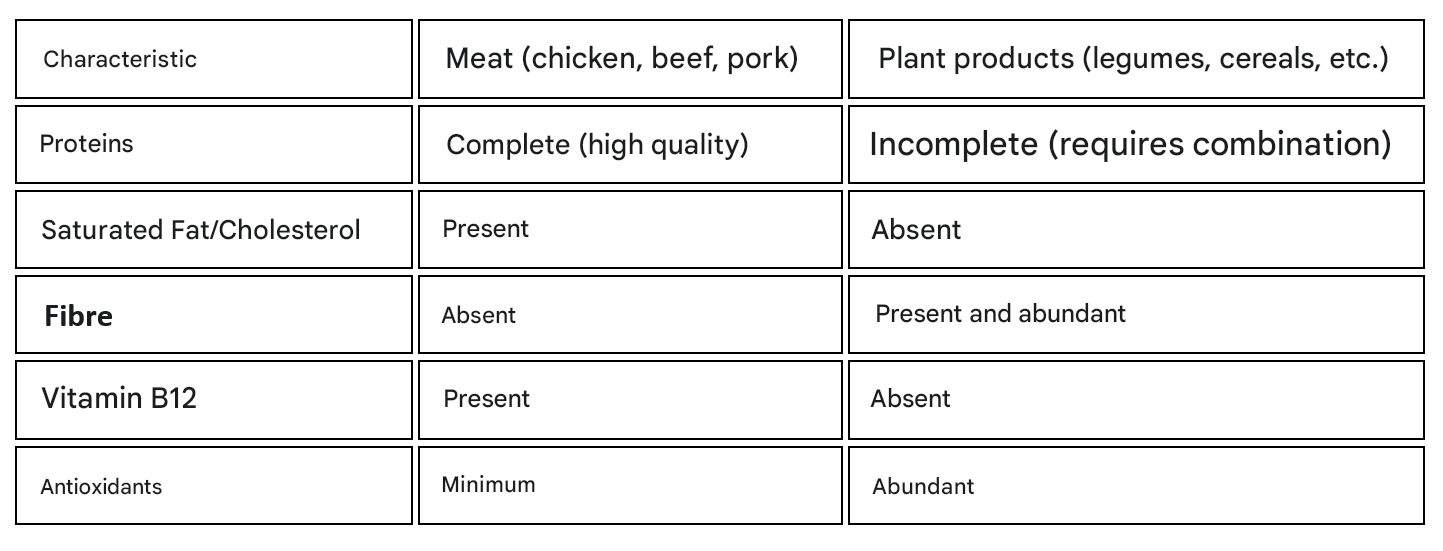
Environmental comparison: meat vs. plant products
From an ecological point of view, the gap between meat production and plant-based agricultural production is the largest and most criticized.
Meat production in general requires many more resources per unit of edible product than the cultivation of plants for human consumption. This is due to the “Law of Conservation of Energy,” namely: every time energy (plant feed) is transferred to a higher trophic level (the animal), much of it is lost in the form of heat, excrement, and vital processes (breathing, movement).
Let’s summarize with a table:
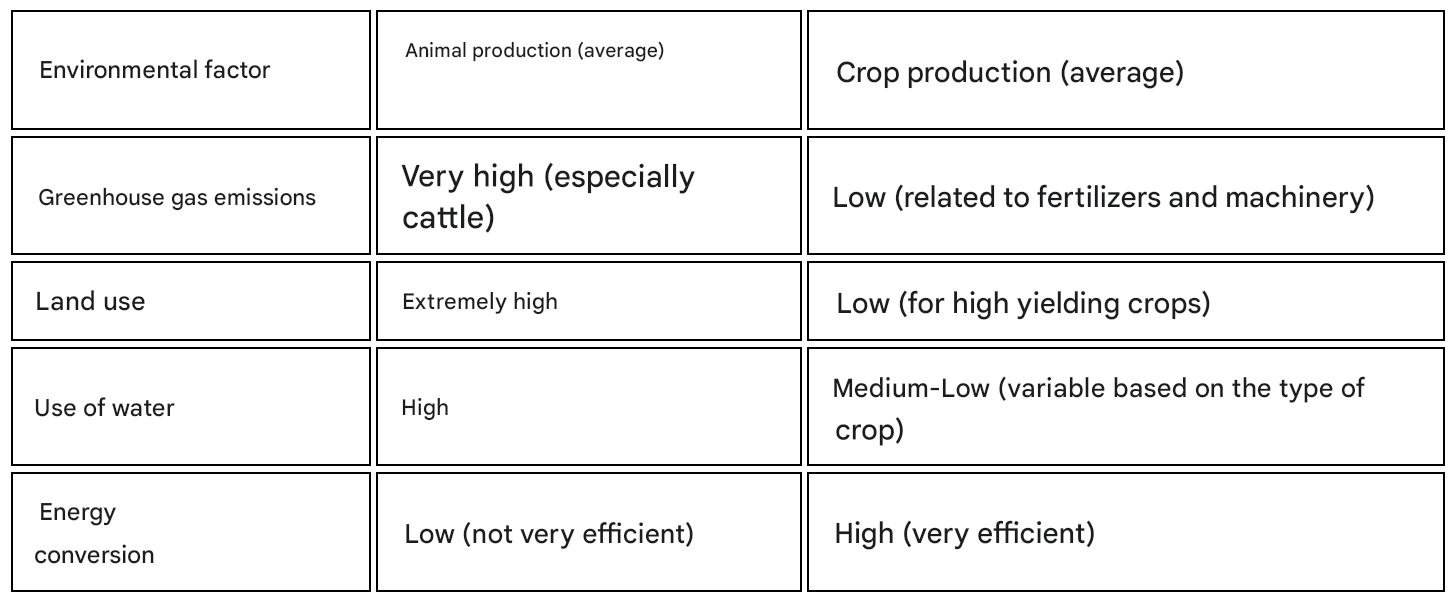
Impact of crops for humans vs. crops for animals
This is the crucial point of global environmental impact: the use of agricultural land.
Most of the world’s agricultural land is not directly dedicated to human food, but to the production of feed for livestock (especially soybeans and cereals) … intended for human consumption (and pet food).
Agriculture for animal feed
Land share
It is estimated that about one-third of global agricultural land (arable) is used for feed cultivation. If grazing is also taken into account, the percentage of global land used for animal production exceeds 80%.
Impacts
Deforestation
Intensive cultivation of soybeans and corn for animal feed is a key factor in deforestation in regions such as the Amazon.
Inefficiency
A huge amount of energy (in the form of feed) is “spent” on animal production, making the system energy inefficient when viewed on a global scale.
Agriculture for human consumption (direct food)
Land use
A relatively small portion of the world’s arable land is used to produce the grains, legumes, fruits, and vegetables that we consume directly.
Impacts
Efficiency
This system is direct and highly efficient. Almost every calorie or protein grown ends up on our tables.
Challenges
It is not without problems, such as the use of fertilizers and pesticides and the intensive use of water for some crops.
The impact of free-range animals
It is important to note that the environmental impact of food systems is almost entirely driven by domestic animal husbandry and the use of land for feed.
Wild animals (wildlife) are part of the natural ecosystem and do not contribute significantly to the greenhouse gas load or land use that results from human food production. Their impact is considered neutral or beneficial to biodiversity and soil health, unless their habitats are reduced or altered by human activity.
In essence, we can conclude that agriculture dedicated to animal feed has an indirect but much greater environmental impact in terms of land use and climate impact than agriculture dedicated to direct human consumption.
IMPORTANT NOTE – We cannot overlook a fundamental piece of the agricultural land use puzzle, namely ‘the allocation of land to bioenergy crops’, which represents a significant and growing variable that competes directly with the production of food for humans and feed for animals. We therefore provide below additional details on the topic just discussed:
Crops for bioenergy (biofuel and biomass)
While the original comparison focused mainly on the food system (human and livestock), the energy emergency and decarbonization policies have created a third, powerful factor of competition for land: the production of renewable energy from agricultural biomass.
Competition for land
Globally, the vast majority of agricultural land is still dedicated to food production (with animal husbandry accounting for the largest share). However, dedicated energy crops are rapidly gaining ground, especially in contexts such as the European Union, where there are binding targets for renewable energy:
Pressure on “arable land” – Crops grown to produce biogas, biomethane, or biofuels (such as corn, sorghum, rapeseed, and sunflower) directly take away land that could otherwise be used for food crops. This is particularly true in industrialized or densely populated countries with limited agricultural expansion.
Impact of EU Policies – The European Renewable Energy Directive (RED II) sets ambitious targets for the use of biofuels and other bioenergy. For example, the EU target is to reach 42.5% of energy from renewable sources by 2030, which implies a significant increase in demand for biomass. This demand, if not met by residues and waste, translates into a growing need for dedicated crops.
Additional environmental challenges
The growing demand for energy crops not only creates competition with food, but also raises specific environmental concerns if managed unsustainably:
Soil degradation – Dedicated energy crops are often grown in intensive monocultures (e.g., corn for biogas), which can accelerate soil erosion, reduce soil organic matter, and increase pressure on fertilizer and pesticide use, problems that intensive agriculture in general already entails (as reported in studies on agricultural soil).
Indirect impact (ILUC) – A key concept in this area is Indirect Impact on Land Use Change (ILUC). If Europe devotes its land to biofuel production, it shifts food production to other areas of the world, potentially leading to deforestation ( l conversion of forests or pastures to cropland) outside the EU to compensate, partially or completely negating the climate benefits of biofuel.
We must therefore note that, while the enormous demand for feed for livestock (80% if pasture is taken into account) remains the main factor in agricultural land consumption, the demand for biomass for energy adds a significant stress factor, transforming land use from a predominantly food issue into a trilemma involving food, feed, and energy.
To complete our research and offer an overview for even the most meticulous, we can delve deeper into the two crucial points that link energy crops to sustainability and agricultural land use with an in-depth look at ILUC and RED II/III.
In-depth analysis of ILUC and RED II/III
The concept of ILUC (Indirect Land Use Change)
When it comes to biofuels (biodiesel, bioethanol) and biomethane from dedicated crops, the biggest challenge is not only how much land they occupy, but what happens elsewhere to compensate.
ILUC (Indirect Land Use Change) is the indirect environmental impact that occurs when crops intended for energy production replace food or feed crops in a given region (e.g., Europe). This shifts the demand for food/feed to another area of the world, such as South America or Asia.
To mitigate the consequences of this shifted demand, farmers in those regions are incentivized to convert non-agricultural areas, such as forests, peatlands, or pastures, into arable land.
Why is this a critical issue? The conversion of these ecosystems (especially forests and peatlands) releases huge amounts of carbon stored in the soil and vegetation, often negating the emission reduction benefits expected from the biofuel itself.
ILUC is the reason why EU policies tend to favor biomass and biofuels obtained from waste, residues (such as used cooking oil or agricultural waste), and non-food crops (algae or crops grown on degraded land), considering them to be at lower ILUC risk.
European policies and their implications
European directives (such as RED II – Renewable Energy Directive) are the main driver of demand for energy crops and define the rules of the game, which we summarize in this table:
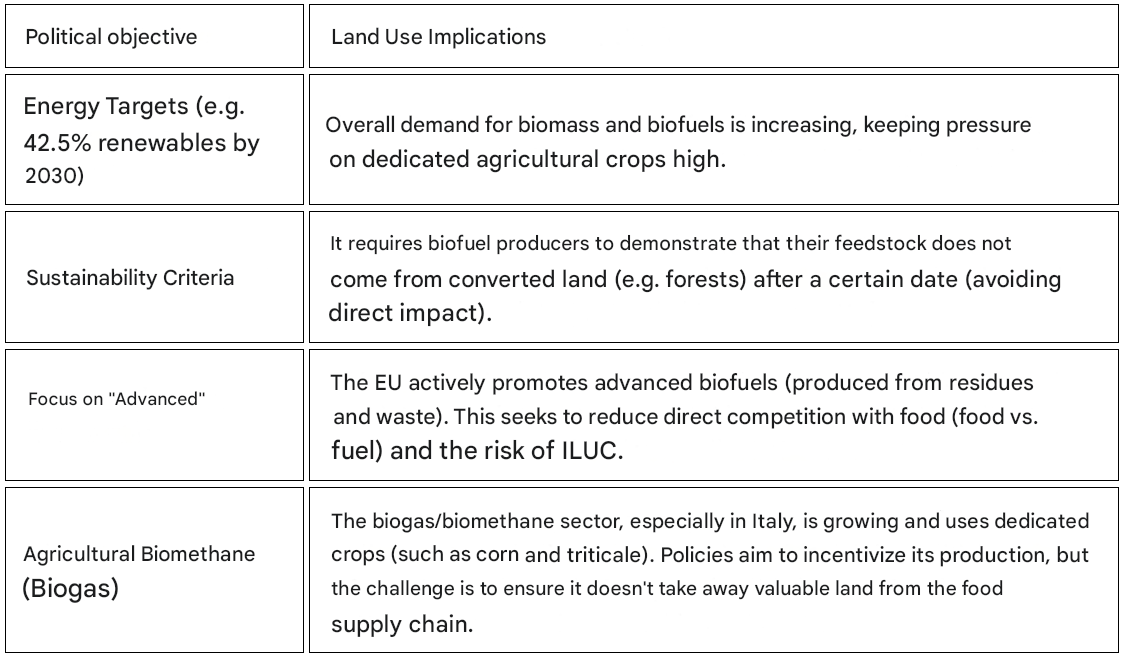
Therefore, the debate is no longer just about how much land they occupy, but what land and with what consequences at a global level.
We also see how important it is to consider one of the crucial issues of sustainability in Europe, namely the intersection between energy policies, land use, and food security.
The link between the concepts of ILUC and RED II/III and competition for agricultural land is direct and quantifiable, especially at the European level.
Direct competition ‘for the plate’: European figures
The most obvious way in which biofuel policies compete with the food supply chain is through the direct use of food and feed crops:
Land taken away – It is estimated that around 9.6 million hectares (9.6 million ha) of agricultural land within the European Union is used to grow raw materials (such as rapeseed, corn, wheat, and soybeans) for the production of bioethanol and biodiesel (and partly also biomethane).
The impact on food security – This area has been equated with that needed to feed approximately 120 million people. The problem is therefore not an absolute shortage of food, but the fact that the use of these crops as fuel rather than food (for humans or animals) creates upward pressure on food commodity prices and generates demand that must be met elsewhere.
The impact on the animal supply chain – Most of these crops are oilseeds (rapeseed, soybeans) or cereals (corn). In the European context, soybeans and corn are essential components of feed for intensive livestock farming. If the EU chooses to burn these crops to produce energy, it increases its dependence on feed imports (often soybeans from countries at high risk of deforestation), indirectly exacerbating the problem we mentioned at the beginning (land use for animal feed).
The critical role of ILUC in the European context
The concept of ILUC (Indirect Land Use Change) is the mechanism by which European energy policy exports the environmental impact of its demand for biofuels, which manifests itself in the following ways:
- The displacement effect (Land Displacement): a European farmer decides to grow rapeseed for biodiesel because it guarantees a subsidized price (driven by energy policy). This reduces the domestic supply of rapeseed or corn for animal feed. To compensate, the feed industry imports more soybeans or palm oil from non-EU countries (e.g., Brazil, Indonesia).
- Hidden emissions: in these countries, forests or areas with high carbon content (such as peatlands) are converted to make way for soybean or palm cultivation (which does not necessarily come from Europe). The CO₂ emissions resulting from this deforestation or conversion are ILUC emissions.
- Climate inefficiency: this hidden impact can be so high that it makes biofuels derived from dedicated crops worse for the climate than the fossil fuels they are supposed to replace.
The European regulatory response (RED II and RED III)
Recognizing this competition and the ILUC risk, the European Union has modified its policies (in particular with the Renewable Energy Directive – RED II, and its revision RED III) with:
- Limiting “Food vs. Fuel” crops: RED II introduced a limit and a gradual phase-out (progressive elimination by 2030) for biofuels derived from raw materials classified as high ILUC risk. A prime example is palm oil, which was the first to be classified as high ILUC risk and is therefore being phased out of biofuel incentives.
- Promotion of “Advanced” fuels: the EU is pushing for so-called advanced or second-generation biofuels. These are produced from: Waste and residues such as used cooking oil (UCO), animal fats, forestry waste, or agricultural residues; Non-food crops such as algae or crops grown on degraded land (which do not compete with food or feed production).
The future goal? The intent of the most recent legislation (RED III) appears clear: to decouple the energy sector from the agricultural sector in terms of land use, incentivizing renewable energy sources that do not compete directly or indirectly with food and feed production.
——–
Notes on the reliability of our content
Why we are reliable
In a debate such as that on the food system, the reliability of information is everything. The content presented is reliable because it reflects the scientific consensus and official statistics on the nutritional and environmental impacts of food, which our site constantly analyzes and studies with the usual objectives of not being influenced by biased news, being neutral, clear, and available to those who appreciate our work and seek insights and reflections not found elsewhere.
The reliability of these analyses is based on two main pillars: standardized nutritional data and globally recognized environmental impact metrics.
The nutritional data (meat vs. vegetables) we have provided
The data comes from food composition tables compiled by national and international research bodies (such as the USDA in the United States or CREA in Italy) and from guidelines issued by public health organizations.
The iron Eme, vitamin B12 (exclusive to animal products), and saturated fat differences in chicken meat compared to beef are not up for debate; they are established biochemical and nutritional facts. Any criticism can only concern the specific portion analyzed (for example, if you compare chicken with skin or extremely lean red meat), but not the general principle.
The environmental impact data (the most critical context) we have provided
The environmental analysis we researched for this article is based on the Life Cycle Assessment (LCA) methodology.
Scientific sources
The impact hierarchy (beef > pork/chicken > vegetables) is established by analyses and reports from large intergovernmental organizations, such as:
FAO (Food and Agriculture Organization of the United Nations), which has conducted exhaustive studies on the impact of livestock farming, particularly on greenhouse gas emissions.
Global academic studies – Most high-level publications (e.g., studies published in journals such as Science and Nature) confirm the substantial difference in impact between ruminants (high in methane and land use) and non-ruminants (low).
What criticism might our content attract?
We know that our neutral approach to research and documentation may attract criticism from those who feel they must defend their positions a priori. We are used to these situations, which in fact arise frequently. We are so prepared that we can predict what criticisms might arise. Here are some of them with the responses we would give (and which we are already giving here):
Potential criticism: “The environmental figures are exaggerated.”
Our response: We recognize that absolute figures (e.g., 10 kg or 20 kg of CO2e per kg of meat) may vary depending on the calculation method. However, the hierarchy of impact (beef pollutes much more than chicken, which in turn pollutes much more than soy) is an irrefutable scientific consensus.
Potential criticism: “Extensive/regenerative agriculture is not considered.”
Our response: While it is true that regenerative agriculture can reduce environmental impact, most of the market still operates using conventional systems. Scientifically, the benefits of these practices, while they exist, are not sufficient to reverse the environmental impact hierarchy between large-scale cattle farming and large-scale chicken/vegetable farming.
Potential criticism: “Plant-based products do not provide complete nutrients.”
Our response: We want to maintain a certain balance in this response as well, so we say that it is a fact that plant proteins (such as those in legumes) are only complete when combined. This does not diminish their importance, but highlights that a diet is effective when it is balanced and based on the synergy between different food sources.
Potential criticism: “Agriculture pollutes with pesticides/fertilizers.”
Our response: This is true, but the climate impact of agriculture is dominated by the use of nitrogen fertilizers. However, most of these fertilizers are used to grow animal feed, making the problem indirectly related to livestock farming.
We would like to remind you that we are always available to engage with accredited, scientifically structured, and recognized organizations to make any necessary adjustments to the information provided.