We now address a topic that we believe will be interesting, especially because it allows us to overturn a very widespread perception: the idea that “more chickens are slaughtered today than ever before” without considering how and why the relative number of animals needed to produce the same quantity of meat has changed over time: a change often ignored by those who blame the poultry sector.
In recent decades, the poultry sector has undergone a profound transformation, often only half-reported.
It is true that global chicken production has increased, but what is rarely explained is that to obtain the same amount of meat, far fewer animals are needed today than in the past .
This result was not the result of chance, but rather of a combination of genetic, management, and health improvements that have revolutionized modern livestock farming.
Fewer chickens for the same meat: a counterintuitive fact
Until a few decades ago, a broiler chicken had very different characteristics than today:
- was growing more slowly
- developed less muscle mass
- was more vulnerable to disease and infection
- had higher mortality rates
This meant that, in order to produce one ton of meat, it was necessary to raise and slaughter many more animals. Today, thanks to advances in poultry farming, the situation has changed radically: the yield per chicken has increased, while mortality has decreased. The result is simple: fewer chickens raised and slaughtered to obtain the same amount of meat .
Let’s now take a look at why this was possible.
Genetic improvements: more muscle, less waste
Genetic selection has nothing to do with invasive manipulation: it’s a slow process, based on crossbreeding the healthiest and best-performing individuals. This has led to chickens that:
- they convert feed into meat better
- they grow more evenly
- develop greater muscle mass, especially in the chest and thighs
A 1960s chicken weighed an average of 1 kg after 8 weeks.
Today, at the same time, it can exceed 2.5 kg.
This means that a single animal produces more meat , reducing the overall number needed.
Health and biosecurity: fewer infections, less mortality
Another key element is the improvement of health conditions:
- more controlled environments
- biosecurity protocols
- targeted vaccinations
- constant monitoring of animals
In traditional farms of the past, infections were frequent and often devastating. Today, however, mortality is dramatically lower. This not only improves animal welfare, but also reduces the number of chickens needed to achieve the same production volumes.
Efficiency and sustainability: an often underestimated impact
It should therefore be underlined that producing more meat with fewer animals also means:
- less feed consumption
- less water use
- fewer emissions per kg of meat produced
- less organic waste to manage
- less pressure on agricultural land
It is an aspect that rarely enters into public debate, but which represents one of the most significant advances in modern agriculture.
Why then does this information not reach the consumer?
The public narrative tends to focus on the absolute number of animals slaughtered, ignoring the production context. But if we look at yield per bird , the story changes completely: modern poultry farming is much more efficient and requires fewer chickens to meet food demand.
The idea that “more chickens are being killed today than ever before” is therefore only partially true, especially since the population now choosing to eat chicken is much larger than in the past. The more relevant reality is that for every kilo of meat produced, the number of birds required has decreased significantly . This result has been achieved thanks to decades of research, innovation, and improved farming conditions.
Discussing this change is essential to truly understanding how the modern poultry supply chain works and to valorising the progress that has made production more efficient, safer and more sustainable… and this is what we are doing at www.moreaboutchicken.com and www.nutriamocidibuonsenso.it
We now provide you with official numerical data , tables and textual graphs based on FAO, Our World in Data and Faunalytics sources .
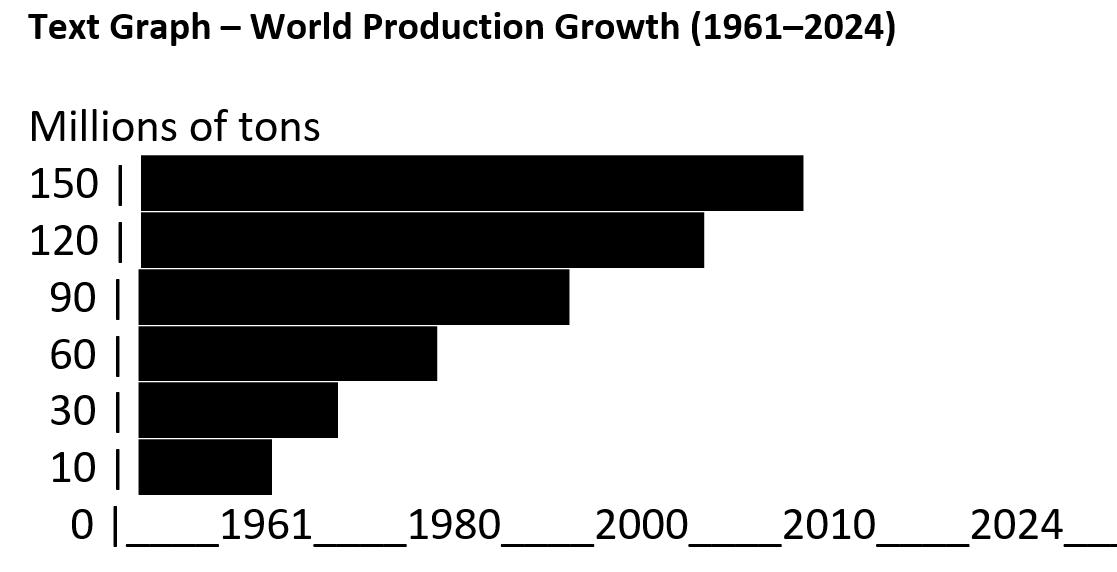
Global chicken production: +1,000% since 1961
According to FAO data, world chicken meat production has increased from around 9 million tonnes in 1961 to over 140 million tonnes in 2024 Our World in Data .
How much did a chicken “yield” yesterday and how much does it yield today?
One of the most significant changes concerns the average weight of broilers. Today, a single chicken produces up to 2.5 times more meat than it did in the 1960s.

Mortality: from chronic problem to exception
In traditional livestock farming in the past, infections such as colibacillosis, enteric necrosis, infectious bronchitis, and many others were common and often fatal. Today, thanks to biosecurity, vaccinations, and environmental management, mortality is much lower.
Indicative data on mortality (recent scientific sources)

Less mortality = fewer chickens to raise to obtain the same volume of meat.
Food efficiency: another decisive factor
Feed conversion ratio (FCR) indicates how many kilograms of feed are needed to obtain 1 kilogram of live weight. Today, approximately half the feed is needed to obtain the same weight.

How many chickens were needed yesterday to produce 1 ton of meat?
Let’s put the data together.
Simplified calculation
- 1960: average chicken 1 kg → carcass yield ~65% → 0.65 kg meat/chicken
- 2024: average chicken 2.6 kg → carcass yield ~70% → 1.82 kg meat/chicken
Chickens needed per 1 ton (1,000 kg)
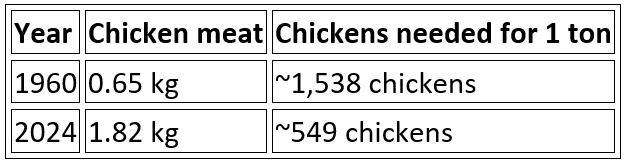
Today, approximately 64% fewer chickens are needed to produce the same amount of meat.
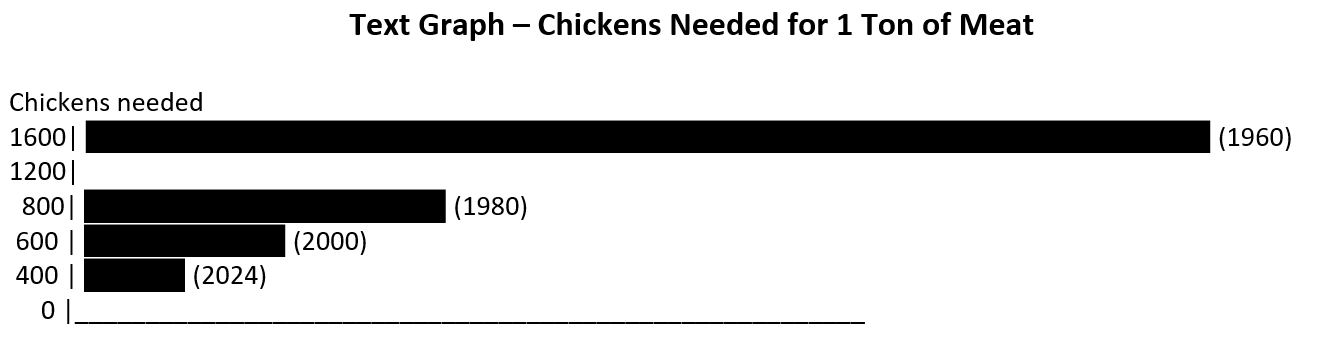
FAO confirms that production efficiency is one of the main drivers of sustainable growth in the poultry sector. The result is a more efficient, more sustainable sector capable of producing more meat from fewer animals.