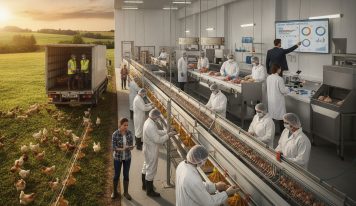
Independent Observatory on Poultry Reputation – First edition
Executive Summary
In the first quarter of the year, the reputation of the Italian poultry sector shows a clear trend: consumption remains solid, but confidence is not growing. The public is not hostile: it is confused, disoriented, and often misinformed.
The 5 main trends:
- Increase in emotional anti-livestock narratives ‑.
- Rise of fake news about antibiotics and animal welfare.
- Growing interest in transparency and traceability.
- Poor presence of the sector in public conversations.
- There is a significant gap between institutional communication and real perception.
The 3 emerging critical issues:
- confusion between “Italian chicken” and “chicken raised in Italy”;
- distorted narratives on the topic of antibiotics;
- perception of opacity regarding intensive farming.
The 3 opportunities:
- explaining science in a simple way;
- show processes, not slogans;
- create credible and independent spokespeople.
1. The context
The Italian poultry sector is among the most advanced in Europe in terms of health and production standards, but this doesn’t automatically translate into trust.
The reason is simple: reputation doesn’t follow data, it follows narratives.
And today the dominant narratives are:
- emotional,
- simplified,
- often hostile,
- almost always without any contradiction.
The sector responds poorly, late, or defensively. This creates a communication vacuum that others fill.
2. Public sentiment analysis
Sentiment is mostly neutral, with peaks of negativity when the following emerge:
- activist videos,
- news on avian flu,
- discussions about antibiotics,
- sensationalist content.
The prevailing emotions:
- curiosity (the public wants to understand),
- distrust (does not trust official sources),
- fear (health, food safety),
- anger (when he perceives opacity).
3. Narrative criticalities of the quarter
The most widespread fake news:
- “90% of chickens are full of antibiotics”
- “Factory farming is illegal”
- “Italian chicken is all imported”
- “All farms are the same”
- “Chicken is bad for your health”
Media distortions:
- use of non-representative images,
- alarmist headlines,
- confusion between isolated cases and the system.
Internal critical issues:
- overly technical press releases,
- lack of storytelling,
- little presence on social media,
- no recognizable spokesperson.
4. Communication opportunities
Topics that the sector could cover:
- animal welfare explained simply;
- what does “ antibiotic free” mean;
- how the supply chain works;
- because chicken is the most controlled meat;
- what really happens in a modern farm.
Strategic opportunities:
- Guided transparency: show processes, not slogans.
- Scientific dissemination: explaining without simplifying.
- Independent spokespeople: credible, non-institutional figures.
5. International benchmark
( Editor’s note: A benchmark is a standard parameter or reference point used to compare the performance of a company, product, or financial instrument. It is used to measure quality, efficiency, and performance compared to industry leaders to improve one’s strategies. It derives from the English “test bench” (standard, touchstone, reference parameter). In finance, it is the index that indicates market performance, used to evaluate whether an investment fund is performing well. In business (Benchmarking) it is understood as the systematic comparison between one’s company and the best competitors to copy or improve their practices (best practice).
- The US is aiming for radical transparency (video, data, virtual tours).
- France unites institutions and communicators.
- The UK excels at crisis management.
- The Netherlands is a leader in traceability.
Italy can learn a lot, especially about:
- opening,
- dialogue,
- response speed,
- clarity.
6. Recurring errors in the Italian sector
- Speak to the public, not with the public.
- Respond only when there is a crisis.
- Using incomprehensible technical language.
- Avoid “uncomfortable” topics instead of addressing them.
- Confusing promotion with information.
7. Operational recommendations
- create simple content on 3 key topics;
- define a spokesperson;
- monitor online conversations.
- launch a structured editorial plan;
- start collaborations with communicators;
- produce short transparency videos.
- build a comprehensive reputation strategy;
- create a communications competence center;
- integrating data, science, and storytelling.
Bottom line: The poultry industry’s reputation isn’t in crisis, but it’s on hold. The public isn’t exactly hostile, but it’s waiting. Those who speak with clarity, transparency, and common sense will lead the conversation.
The Observatory was created for this: to give the sector a tool it has never had.
For this reason I also facilitate the proposal for the “MANIFESTO FOR THE POULTRY COMMUNICATION OF THE FUTURE”.

MANIFESTO FOR THE POULTRY COMMUNICATION OF THE FUTURE
Towards a more understandable, more credible, and more humane sector
Premise
The Italian poultry sector is among the most advanced in the world in terms of controls, health standards, and production quality. Yet, its reputation does not reflect this value.
Why? Because communication hasn’t kept pace with the evolution of the sector .
It has remained defensive, technical, self-referential. It has talked about itself, not with people .
This Manifesto was born to propose a paradigm shift:
- From communication that reassures to communication that explains.
- From defense to transparency.
- From reaction to proactivity.
The 10 Principles of Future Poultry Communication
- Transparency is a duty, not a risk
Showing processes, data, and choices doesn’t weaken: it strengthens.
- Science should be made understandable, not simplified.
The public understands much more than the industry thinks.
- People don’t want slogans: they want answers.
“100% Italian”, “guaranteed quality”, “controlled supply chain” are no longer enough.
- Critical issues should not be avoided: they should be explained
Antibiotics, animal welfare, factory farming: silence fuels suspicion.
- Communication is not promotion
It’s building trust, day after day.
- Reputation cannot be defended: it is deserved
And it is deserved with consistency, openness and common sense.
- The sector must speak with a human voice
Less technical jargon, more clarity. Fewer press releases, more dialogue.
- Speed is part of credibility
In crises, whoever speaks first leads the narrative.
- Stories matter as much as data
People remember what excites them, not what reassures them.
- The future belongs to those who know how to make themselves understood
Complexity is not an obstacle: it is a narrative opportunity.
10 MISTAKES TO AVOID (Even though they’re the norm today)
- Speak only when there is an attack.
- Respond with incomprehensible technicalities.
- Using generic and unreliable images.
- Ignore questions from the audience.
- Confusing “communication” with “advertising”.
- Hide processes instead of showing them.
- Minimize problems instead of contextualizing them.
- Delegate everything to press releases.
- Not having recognizable spokespeople.
- Thinking that “the chicken will sell anyway”.
10 IMMEDIATE ACTIONS FOR COMPANIES AND ASSOCIATIONS
- Open farms (physically or virtually)
Tours, videos, explanations: transparency is the first cure.
- Create simple content on 5 key topics
Antibiotics, well-being, supply chain, controls, sustainability.
- Answer the public’s questions, not their prejudices
The difference is huge.
- Choose a credible spokesperson
Better a veterinarian than a marketing director.
- Monitor online conversations
Not to defend oneself, but to understand.
- Collaborate with independent communicators
Credibility is also built through osmosis.
- Prepare a crisis management protocol
He who improvises loses.
- Use human language
No “integrated biosecurity”: explaining what it means.
- Tell true stories
Breeders, researchers, technicians: the sector is full of competent people.
- Publish data, not slogans
Trust comes from numbers, not from clichés.
A 5-YEAR VISION
Let’s imagine a poultry sector that:
- publishes annual transparency reports
- opens farms to the public (physically or virtually)
- collaborates with universities and communicators
- responds to crises within 24 hours
- speaks with a single, clear and coherent voice
- becomes a European model of agri-food communication
This isn’t a utopia. It’s a strategy that can start from here.
Pietro Greppi – communications advisor
“© 2025-2026. All rights reserved. No part of this document may be reproduced or shared without express written consent.”