For inconsistency: that is, when what is said does not coincide with what is done or shown
Inconsistency arises when the message doesn’t match the behavior.
In the poultry industry, this happens often: not because the industry doesn’t work well, but because it poorly describes what it does well .
The result is a paradox: an advanced, controlled, innovative sector… that communicates as if it had something to hide.
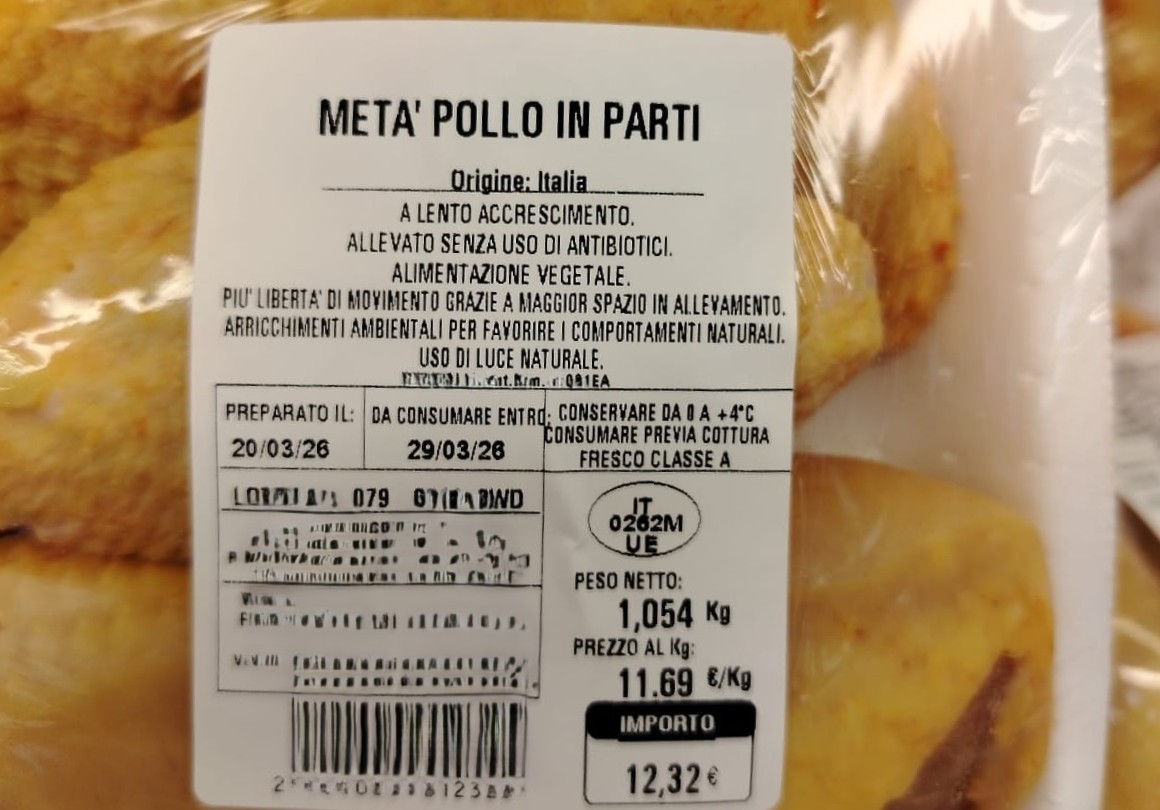
The following reflections arise from viewing some recent “new” labels on poultry products distributed through large-scale retail outlets (as seen in the photo at the beginning of this article) and yet another news video denigrating poultry farms. This video, as is increasingly the case, has highlighted the sector’s poor preparation for neutralizing and anticipating the responses to criticisms leveled at it. This criticism, regardless of actual sales figures, actually alienates consumers and risks forcing the sector to respond defensively.
The communication short circuit: virtuous labels on a product already slaughtered
In recent years, sector communication has focused on:
- reassuring but generic spots
- labels that speak of animal welfare, care, respect
The problem is not the content, but the context.
claims are applied to a slaughtered product, consumers perceive an inconsistency. Not because the claim is false, but because it appears at the wrong time, on the wrong medium, using the wrong language.

“You talk to me about animal welfare… while I buy a dead chicken. Isn’t that a contradiction?”
This short circuit generates mistrust, and mistrust opens the door to hostile narratives.
Official data that the sector does not communicate (but should)
Italy
- Italy is among the EU countries with the lowest use of antibiotics in production animals: –82% from 2011 to 2022 (source: ESVAC – EMA).
- The Italian poultry sector is antibiotic -free at birth: chicks do not receive antibiotics in the hatchery (source: national guidelines).
- The average mortality rate in broiler chickens is less than 3%, among the lowest in Europe (source: supply chain data).
European Union
- European chicken is produced according to the most advanced animal welfare legislation in the world (Directive 2007/43/EC).
- The EU reduced antibiotic use in animals by 53% from 2011 to 2022 (EMA – ESVAC).
EFSA
- EFSA confirms that the European poultry sector is among the most monitored for biosecurity and food safety.
- Chicken-related zoonoses are steadily declining thanks to mandatory control plans.
ISPRA
- ISPRA certifies that chicken is the meat with the lowest environmental impact among terrestrial animal proteins (emissions, water, soil).
This data is gold. But if it’s not shared, it remains invisible.
Why this inconsistency harms the sector
- Why it breeds mistrust – Inconsistent communication arouses suspicion, not curiosity.
- Why It Looks Like a Fake Strategy – If you only talk about animal welfare on the label, you appear defensive.
- Because it obscures what really works – Innovation, biosecurity, genetics, measurable welfare, antibiotic reduction: all of this remains in the shadows.
- Because it leaves room for others to tell your story – and often they do so in a distorted way.
The root of the problem? Confusing “promotion” with “communication.”
The poultry sector clearly, and unfortunately, confuses promotion with communication.
Promotion is used to sell a product, communication is used to explain a system, a process, a value, …
Today, the industry is almost entirely about promotion. But the consumer of 2026 wants transparency, context, and evidence.
If he doesn’t find it, he looks elsewhere. And elsewhere he often finds misinformation.
We can make a generic example with a short list of “negative myths” and comparing them with reality.
Animal welfare
MYTH
“Industrial chicken lives in terrible conditions.”
REALITY
EU standards are among the strictest in the world. Animal welfare is regulated by precise rules regarding stocking density, lighting, ventilation, environmental enrichment, and veterinary controls. Mortality rates are among the lowest globally (source: EFSA, European Commission).
Antibiotics
MYTH
“Chickens are full of antibiotics.”
REALITY
Italy is among the countries with the lowest antibiotic use in Europe (-82% in 10 years). Antibiotics are used only with veterinary prescription and comply with mandatory withdrawal periods (source: EMA – ESVAC).
Environmental impact
MYTH
“Chicken is unsustainable like all meats.”
REALITY
Chicken has the smallest environmental footprint among terrestrial animal proteins (source: ISPRA, FAO).
It uses less water, less land, and produces less CO₂ than beef and pork.
Intensive farming
MYTH
“Intensive = abuse.”
REALITY
Intensive means efficient , not cruel . Modern intensive farms are controlled technological systems, with optimized and monitored environmental parameters. Animal welfare is measured with objective indicators (source: EFSA).
How to overcome inconsistency? Here are three concrete directions.
- Communicate before the product, not just about the product
Animal welfare must be communicated on the farm, not just on the label.
- Show, don’t declare
Consumers believe evidence, not claims .
- Build a coherent narrative
Consistency arises when:
- what you say matches what you do
- what you do is visible
- what is visible is understandable
The poultry sector already has the substance. What’s missing is the narrative.
Inconsistency is not destiny, … it is a choice
The Italian poultry sector is a leader. But it communicates as if it were under attack. The inconsistency in communication stems not from ill will, but from a cultural void: the belief that “doing well” is enough.
Today, however, that’s no longer enough. Those who don’t communicate coherently, transparently, and anticipatorily lose their narrative. And when you don’t tell who you are, someone else will.
Note from the founder of this blog:
I’ve been working in strategic communications and outreach for over thirty years.
In recent years, I’ve chosen to dedicate part of my work to the poultry supply chain, not as an industry insider, but as an external consultant who critically examines a glaring problem: communication that’s often weak, reactive, and difficult for the public to understand.
To demonstrate what it means to communicate clearly, transparently, and based on data, I founded two blogs — nutriamocidibuonsenso.it and moreaboutchicken.com —which represent a concrete model of how the sector could better communicate itself.
My goal is not to replace the supply chain, but to help it fill a communication gap that currently exposes it to criticism, misunderstandings, and distorted narratives.
My mission
My goal is to help fill a communication gap that currently exposes the supply chain to criticism, misunderstandings, and loss of reputation.
I speak both “for the sector” (therefore to the consumer or potential consumer public) and to the sector, with the belief that better communication is not only possible, but necessary for:
- Help the poultry industry emerge from its communication gray area.
- To tell its story before it’s forced to justify itself.
- To transform data, standards, and innovations into stories the public can understand, remember, and share.
All this with a little method, a little strategy and—why not—even a little light-heartedness.
Because the truth is simple: it’s not enough to do well. You also have to know how to say it.
Pietro Greppi