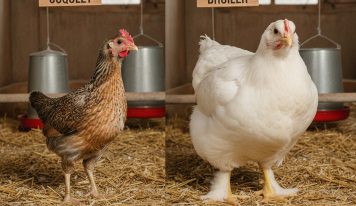
The poultry sector represents the most widespread and consumed source of animal protein globally.
Its numbers are impressive and often raise important questions about production, well-being, and environmental impact. Let’s try to address and describe the most controversial ones, observing them without the influences and exploitation they often generate.
Overall quantity and size
The poultry industry is measured in tens of billions of heads each year. This numerical scale is dictated by global demand for chicken meat (which is cheaper) and eggs.
Annual global production
Broiler Chickens – Over 70 billion heads
Laying hens ( Laying Hens ) – Approximately 7.5-8 billion heads
Quantitative data on European Union production (estimate)
Broiler chickens – Approximately 7 billion heads
Laying hens ( Laying Hens ) – Approximately 400-450 million heads
These numbers make chickens the most numerous farmed animal in the world. These numbers are justified by the size of the global human population, which requires access to high-quality, low-cost protein sources.
Mortality rate and causes in intensive farming
Mortality rates in factory farms are a crucial indicator of welfare, management, and profitability. Mortality rates are kept very low thanks to rigorous health protocols and are influenced by animal genetics and population density.
Typical mortality rates
Broilers
The mortality rate considered acceptable is generally very low, often less than 3-5% of the total flock over the short life cycle (35-45 days). Rates above 5% are considered a warning sign of management problems or disease (which prompts in-depth analysis to identify eliminateable causes).
Laying hens
The rate is generally higher, given the longer life (about 1 year of production). Cumulative annual losses can vary between 6% and 10% .
Prevalent causes of mortality in livestock farming
The main causes are divided between problems related to genetic selection and infectious agents:
Metabolic and cardiac problems (in broilers )
The main cause is genetic selection for rapid growth . This tends to lead to a disproportion between muscle growth and the development of internal organs and the skeletal system. These factors, however, are constantly being addressed in upstream selection to correct/eliminate these findings, taking into account that breeders and breeding companies are always in the best interest of having healthy animals.
Ascites (water retention) and sudden death syndrome ( SDS ) are common, caused by stress on the cardiovascular system that cannot support the rapidly growing body. These cases are also the subject of ongoing upstream selection interventions to correct/eliminate these findings, keeping in mind that breeders and breeding companies are always in the best interest of having healthy animals.
Infectious and respiratory diseases
Despite the use of vaccines and biosecurity, bacterial or viral infections (such as Marek’s disease, coccidiosis, or bronchitis) spread rapidly in high-density environments wherever a condition (always involuntary) occurs that facilitates their onset.
Environmental and management factors
Dysentery and lesions due to wet bedding or poor hygienic conditions.
Heat stress (excessive heat or cold) due to inadequate ventilation or heating.
The comparison: mortality in nature
To make a reliable comparison, one should not consider the domestic chicken (which does not exist in the wild), but its wild ancestor, the red junglefowl ( Gallus gallus ), or other wild ground birds.
The comparison reveals a brutal reality for animals in the wild:

Key points of the comparison
Predation
In nature, the vast majority of chicks and young animals (up to 12 weeks) are killed by predators (birds of prey, mammals, reptiles). This factor is completely absent in farms.
Exposure and hunger
Climate variations, limited access to water, and difficulty finding adequate food lead to extremely high mortality rates among young wild animals.
Longevity
A broiler chicken raised in a breeding flock has a short life expectancy (about 6 weeks), reducing the time it is exposed to risk factors. Wild birds that survive the first few months have a lower adult mortality rate, but the overall survival of a brood is infinitely lower than the production of a breeding flock.
In summary, while farmed chickens face specific challenges related to their genetics and stocking conditions, their likelihood of dying is far lower than that of their counterparts in the wild, where the dominant factor is predation and environmental failure .
By “environmental failure,” we refer to all those natural, uncontrolled factors that prevent animals from surviving in the wild, especially in the early stages of life. Essentially, it’s the lack of environmental support that leads to death, rather than an internal problem within the animal (such as disease or metabolic disorder).
There are at least three main elements that constitute “environmental failure” for feral chickens or land animals:
Food failure (hunger)
A wild chick must learn to forage for food quickly.
What happens: If the availability of insects, seeds and sprouts is poor due to drought, prolonged cold or low competition , chicks are unable to obtain the energy needed to grow and maintain body temperature.
Result: starvation or weakening to the point of making them easy prey.
Exposure to the elements
Wild animals are directly exposed to the elements, without artificial shelter or heating.
What happens: Too cold temperatures, torrential rains or high humidity (which affects the plumage) can quickly cause hypothermia in chicks, which have a limited ability to thermoregulate.
Result: death from heat stress or respiratory diseases resulting from prolonged exposure to cold/dampness.
Lack of effective shelter
The nest or shelter in nature is often vulnerable.
What happens: If the shelter chosen by the hen is inadequate or compromised by floods, wind, or fires , the chicks are exposed to predators and bad weather. Furthermore, parasites (ticks, mites) are much more difficult to control in an unsanitary environment.
Result: increased rate of predation or debilitation due to parasitic infestations.
In contrast, in conventional farming , all these environmental factors are actively controlled (constant provision of food and water, heating, ventilation, physical protection from predators). This explains why the mortality rate in farms, despite genetic issues, is drastically lower than in nature.