Where future laying hens come from, how many fertile eggs breeders produce, and why managing roosters is one of the most technical jobs in modern poultry farming
When we talk about laying hens, we usually think about the eggs we buy at the store. But long before a hen starts laying, she comes from a completely different world — a world most consumers never hear about: breeder farms, where the “mothers” and “fathers” of future layers live.
These farms don’t produce table eggs.
They produce fertile eggs — and from those eggs, the pullets that will eventually become the hens laying our daily eggs.
Without breeder farms, there would be no laying hens.
And without laying hens, no eggs.
How many eggs does a breeder hen produce?
(and why it’s far fewer than people think)
A commercial layer can produce 330–350 eggs per year.
A breeder hen produces about half of that: roughly 160–180 fertile eggs per cycle.
Why such a big difference?
Because breeder hens are not selected for “egg numbers”. They are selected for:
- fertility
- embryo quality
- robust, uniform chicks
- genetic consistency
- the long-term productivity of their daughters
Every egg is a potential chick.
Every chick is a future laying hen.
And every laying hen is a year of egg production.
Quantity matters — but quality matters more.
The role of roosters: few in number, essential in function
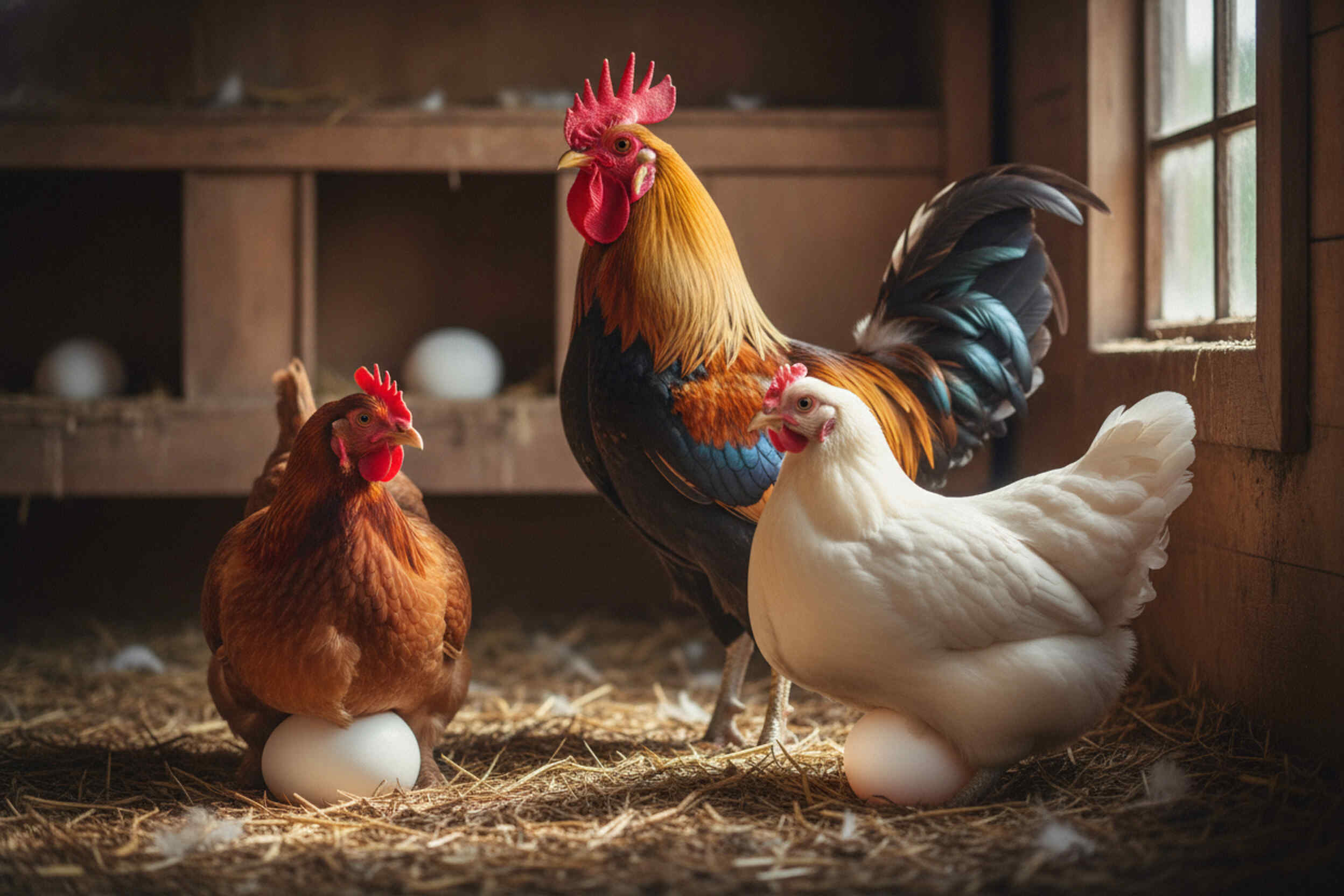
Breeder farms keep very few males: only 1 rooster for every 14–20 hens (about 5–7%).
This ratio is critical:
- too many males = stress, aggression, injuries
- too few males = lower fertility
Managing roosters is one of the most technical and specialized tasks in poultry production.
Breeder managers:
- raise males separately until 16–18 weeks
- introduce them gradually to avoid aggression
- monitor body weight closely
- rotate males to maintain fertility
- replace overly dominant or aggressive males
- keep “reserve males” ready for introduction
A rooster that is too heavy cannot mate effectively.
A rooster that is too light loses dominance and stops mating.
A small detail — but it can make or break fertility.
Ensuring fertility: a daily, precise, almost artisanal process
Fertility is not just about the rooster.
It’s the result of a finely tuned system involving:
- uniform body weight in hens
- good litter quality (essential for natural mating)
- controlled lighting programs
- well-managed nest boxes
- frequent egg collection
- constant monitoring of fertility and hatchability
Every day, breeder farms check:
- percentage of fertile eggs
- hatchability
- male behavior
- signs of stress or overmating in hens
It’s a technical job, but also a job of observation, timing, and experience.
MYTHS & FACTS
The most common misconceptions about breeder hens
MYTH 1 — “Breeder hens lay as many eggs as commercial layers.”
FACT — They don’t. Breeder hens produce 160–180 fertile eggs, far fewer than commercial layers.
They are selected for fertility and chick quality, not egg numbers.
—
MYTH 2 — “Any rooster can fertilize eggs.”
FACT — Managing roosters is a highly technical task.
It requires the right male-to-female ratio, weight control, gradual introduction, rotation, and behavioral selection.
—
MYTH 3 — “A fertile egg is automatically a good egg.”
FACT — A fertile egg must also be:
- clean
- intact
- healthy
- with a viable embryo
- suitable for incubation
Not all fertile eggs meet these standards.
—
MYTH 4 — “Breeder farms are just like egg farms.”
FACT — They are completely different.
Breeder farms don’t produce table eggs — they produce chicks.
Their management is more complex, and every detail affects fertility.
—
MYTH 5 — “Breeder farms have nothing to do with consumers.”
FACT — Every laying hen that produces the eggs we buy comes from a breeder farm.
If reproduction fails, the entire supply chain stops.
Why this matters to anyone who eats eggs
Because the egg supply chain begins here.
If the first link doesn’t work, nothing else works.
Breeder farms are:
- the starting point of the entire system
- the place where quality is created
- the most technical and least visible segment
- a concentration of expertise that rarely reaches the public
Understanding breeder farms means understanding where eggs truly begin.