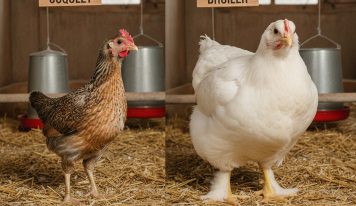
Don’t worry, you won’t find any diets for overweight people here, but simply a little insight into the nutrition of chickens destined for our food chain: the ones you find in the supermarket, ready-made or prepared as quarters, wings, breasts , etc.
They’re called meat chickens, and those in the industry also call them “broilers“. They’re called this because the purpose of raising them is to provide us with the nourishment we’re used to getting… by buying it from someone.
We may have already written this, but some things are worth repeating often.
Let’s be clear: the alternative would be to raise and cultivate our own food. But that’s objectively more convenient, regardless of any cynicism. Try denying it.
There is one aspect that cannot be disputed, and that is the fact that mankind has long been scientifically equipping itself to manage its diet and, among the simplest, most nutritious and economical sources, has found that poultry, it is worth emphasizing, is among those that offers excellent basic solutions.
You’ll hear all sorts of things said and written about how the chickens we bring to our tables are fed, including negative hyperbole. Keep in mind, however, that alarmism often stems from bad faith or blind faith in beliefs that are often irrational and rarely correspond to actual facts.
In every field, there are always those who exaggerate or commit crimes, and who therefore come in handy for those who intend to conduct alarm campaigns by “confusing the particular with the whole” and creating a distorted perception of reality.
Let’s get back to what and how a farmed chicken eats.
As chickens grow, they need to be fed feed that is adapted to their size and overall characteristics, which vary as they grow.
The goal of every modern breeder is to achieve a balance that respects the animal’s well-being. Ultimately, this should also be the case for us humans, who often eat in a disordered, unhealthful, and rarely appropriate way for their age and individual characteristics. In this regard, chickens are therefore better cared for than many people and certainly eat a more balanced diet.
White coats aren’t just found in clinics, hospitals, or research centers dedicated to our health: nutrition experts also work on farms to ensure that every chick destined to become a chicken enjoys the well-being that will guarantee us healthy food along the journey that leads them to our table.
Just as kittens and puppies require different food than adult dogs, the food for a chick is also different from that for a chicken and is primarily a mix of quality corn, wheat, and soy flour, balanced according to the animal’s age.
There’s no point in searching for phantom hormones: you won’t find them. Simply because they’re banned and because the development of these animals, which are larger and healthier than in the past, is linked “simply” to the extreme attention paid to animal welfare in modern farms.
Do any of them get sick anyway? Yes.
But what more is expected of the poultry sector than what the sector is already committed to doing and continues to improve day after day?
Let’s draw a parallel: do you know any humans who are immune to disease, despite having a highly advanced research and prevention system?