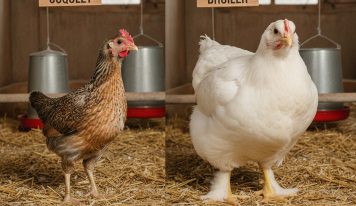
Organic poultry farming is a farming system that complies with strict standards defined by European and non-European regulations. The main objective is to ensure animal welfare, respect their natural cycles, and have a reduced impact on the environment.
The main pillars of organic poultry farming are:
Feed
Animals must be fed organic feed that is certified and sourced from organic farming. Genetically modified organisms (GMOs) are strictly prohibited. Feed must be free from synthetic additives, artificial colorants, and growth promoters.
Space and welfare
Animals must have access to open spaces (pastures). Regulations establish a minimum area per animal both inside and outside the sheds. The density inside the sheds is reduced compared to conventional farms to ensure more space for movement and scratching. Environmental enrichment, such as perches, litter areas, and nests, is provided to allow chickens to express their natural behaviors.
Care and Medicines
Priority is given to disease prevention (hygiene, healthy nutrition, adequate space) rather than treatment. The use of allopathic medicines (such as antibiotics) is strictly limited and only permitted when strictly necessary, in the event of disease, and under veterinary supervision. Preventive use is prohibited. Phytotherapeutic, homeopathic, and alternative medicines are preferred.
Origin of Animals
Chicks used must come from organic breeders or, if unavailable, may be supplemented with conventional day-old chicks (but only within certain limits). Rustic breeds, suitable for outdoor living, are often preferred.
Common misconceptions about organic farming
There are several misconceptions that often lead to a misunderstanding of this type of farming. Here are a few:
“Does organic mean they don’t use antibiotics?”
False.
The use of antibiotics is permitted in case of illness, but only if strictly necessary for the health of the animal, in a much more restrictive manner and with longer withdrawal periods than in conventional farming. Preventive use is always prohibited.
“Are the chickens always outdoors?”
Not always.
Regulations guarantee access to outdoor areas, but the amount of time spent outdoors can be influenced by factors such as climate, season, or the need for protection from predators and viruses (e.g., avian influenza), which sometimes requires confining the animals.
“Is every organic farm a small family-run farm?”
Not necessarily.
There are also large organic farms run by structured agricultural businesses. Size is not a certification criterion, but management rules are.
“Is animal welfare guaranteed only by the organic label?”
It is not the only one.
The organic label undoubtedly offers a high standard of welfare, but it is not the only one. A non-organic farmer can still manage their farm with a strong focus on welfare, for example by choosing more rustic breeds (such as Dual Purpose), providing ample space and taking care of management, even if they do not use organic feed. The human factor and management are fundamental elements in all types of farming.
What happens if antibiotics are used on an organic poultry farm?
The organic regulations are designed to protect animal welfare, which includes the possibility of treating sick animals. However, the rules provide for severe consequences to maintain the integrity of the system. Here is what happens in detail:
Use is strictly limited.
Antibiotics may only be used if a veterinarian certifies that they are the only effective treatment for the animal and that there are no homeopathic or phytotherapeutic alternatives.
The animal loses its organic status.
The individual chicken or the entire batch of chickens that has received the treatment can no longer be sold as an organic product. It must be withdrawn from the organic production cycle and sold as a conventional product. This is a very strong economic deterrent for the farmer.
The rest of the farm retains its status.
If the treatment only affects some of the animals, the rest of the farm that has not received medication retains its organic status, provided that all other regulations are complied with.
In summary, the organic system does not prohibit treatment, but ‘punishes’ it with the loss of certification for the treated animals. This ensures that antibiotics are used only when necessary and not as a matter of routine or prevention.