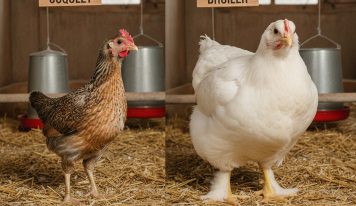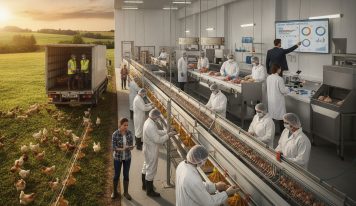
for the production of chicks
of future commercial layers*.
*Let us immediately explain that hens intended for the production of eggs for the food market are defined as “commercial layers”.
The egg is, by its very nature, a perfect construction. The function of breeding farms is to ensure the availability of this natural product for the greatest number of people possible at affordable costs. Such a perfect source of nourishment becomes a social commitment – and not only commercial – to make it continuously available to millions of people.
With the description we will give of how the reproduction of hens dedicated to the production of eggs for human consumption works, we do not pretend to fully convey the innovation and technological development achieved since the origins of this sector in the last century.
But it is nevertheless important, and we will try to convey it, to make people understand that today, in all the phases of breeding and incubation, the best computer systems are used to control all the fundamental environmental parameters intended for this commitment and that the most innovative and advanced materials are the basis of the animal shelter structures.
Furthermore, current nutritional knowledge allows us to ensure that the needs of the animals we care for are met in the best possible way.
Having said this, let’s start by saying that eggs for human consumption come from a supply chain that – especially in Italy – represents excellence. Below we explain how the Italian supply chain is organized.
In the Italian livestock sector, this is one of the few productions that reaches self-sufficiency, completely covering the demand of the national market which, thanks to a supply chain vision, in recent decades has also exported an increasingly large share.
Italian production is in fact guaranteed by approximately 43-45 million laying hens housed in certified, controlled farms distributed throughout the peninsula, managed in compliance with current regulations regarding animal welfare, hygiene and product safety and environmental management of by-products.
It must be said that the quality of management often goes beyond the regulations. This is because the interest of those who deal with this supply chain is constantly oriented towards the search for every possible improvement regardless of the regulations which, as just mentioned, often end up being less demanding than those of the supply chain’s protagonists.
For the uninitiated, thinking about such a high number of animals, almost equal to the national population, raises some questions that we try to answer.
Where do these animals come from?
Commercial laying hens (i.e. those that produce unfertilized eggs intended for human consumption) present in Italian farms are selected and distributed by some specialized companies that own the “parents” ( parents* ) of these animals called breeders: these farms focus on genetic selection and optimal management of the animals to guarantee high productivity and egg quality.
These companies raise the breeders in dedicated farms and take care of the collection of the fertilized eggs and their transportation to dedicated incubation centers where the fertilized eggs are placed in special rooms that reproduce the temperature and humidity conditions that they would find under the hen , allowing after 21 days the hatching of a healthy and vital chick .
* In chickens, the “grand parents” are the parents of the parents, that is, the grandparents. In other words, they are the animals that are used to produce the hatching eggs from which the chicks will be born, therefore:
Grand Parents (Grandparents): are the basic breeders of a chicken genetic line.
Parents (Parents): are the children of the Grand Parents, and are used to produce chickens.
Chicks: are the children of relatives, who are raised for the production of meat or eggs.
Selection: The breeding of Grand Parents and Parents is a practice of genetic selection, with the aim of improving characteristics such as egg production or growth rate.
—– In short, the Grand Parents are the ancestors from which the genetic characteristics of the reproduced chickens derive.
Who are their parents and how are they raised? The breeders.
Breeders are animals selected for characteristics considered better than others. This selection of genetic improvement is not done in Italy: in fact, there are few companies in the world that, through natural mating, select the best individuals (for productive characteristics, character and resistance to disease) future breeders starting from animals of “pure breeds”.
This process is very similar to that applied to dogs, cats, horses, … to improve existing breeds and is based on mating and identifying the best animals in the progeny.
These parents of the laying hens are then brought to Italy and will be dedicated to the production of hatching eggs (defined as belonging to the 2nd level of crossing).
These animals are then placed in farms that are very similar to those for the production of eggs for consumption, with the difference that the breeders include both males and females.
Fertilization therefore occurs naturally thanks to the mating of males with females who live promiscuously in the same environments.
In the environments where the hens live, they find nests, in secluded areas, where they can lay their eggs in peace.
The nests are equipped with conveyor belts on which the laid eggs roll down the inclined planes of the nests.
Through these belts the eggs are taken outside the premises used for animal stabling (stabling means confinement in controlled spaces in which vital functions are guaranteed and monitored) where they are collected in special egg trays and then placed in environments with controlled temperature and humidity to protect the fertilized egg and ensure the survival of the embryo. This operation is repeated twice a day in order to bring the fertilized egg to controlled conditions as soon as possible and avoid thermal stress.
The fertilized egg is kept at about 17-18 degrees and 65-75% humidity so that it remains viable even for several days without starting embryonic development.
How and where do incubation and hatching occur?
The eggs are then sent to the hatcheries, with temperature-controlled transport vehicles. In the hatchery, the fertilized egg is placed in specialized rooms, where the temperature and humidity conditions of natural hatching are recreated, this allows the embryo to develop until the chick hatches.
At birth, the chick is prepared for transport; it is separated from the eggshells that contained it and subsequently subjected to vaccination protocols aimed at preventing some of the main pathologies of the species and is subsequently placed in ventilated boxes.
The vehicles intended for transport are temperature-controlled to ensure the best welfare conditions for the chicks.
For longer transports, rehydrating gel boxes with mineral salts are placed in order to support them until they are placed on the farm where they will easily find feed and water.
In summary then:
Transporting eggs
The eggs are transported to the hatchery using temperature-controlled transport vehicles and with hydraulic suspensions to ensure their integrity and the best preservation of the embryo.
Incubation
In the hatchery, the eggs are placed in rooms where the optimal temperature and humidity conditions are recreated, as in a natural incubation, to allow the development of the embryo.
Preparing chicks for transport
Once hatched, the chicks are separated from their shells and subjected to vaccination protocols to prevent some common diseases.
Transporting chicks
The chicks are placed in ventilated boxes and transported in temperature-controlled vehicles to ensure their well-being. For longer transports, they are provided with rehydrating gels with mineral salts to support them during the journey.
Arrival at the farm
The aim is to ensure that chicks arrive at the farm in good condition, ready to be placed and given feed and water.
Key aspects of selection
Genetic selection
Breeds with the best characteristics for egg production, feed efficiency and disease resistance are chosen.
Breeding conditions
The environment must be controlled to provide the right level of light, temperature and hygiene.
Reproduction
Selected males and females are used to ensure the quality of the offspring.
Incubation
Fertile eggs are collected and incubated under optimal conditions to promote hatching.
Breeding is a key sector to ensure the quality and continuity of animal production, both for meat and eggs. It is based on careful management of genetics, health and environmental conditions of animals intended for breeding.
Key aspects of breeding:
Genetic selection
Animals are selected based on specific characteristics such as productivity, disease resistance and the quality of the final product.
Playback Management
In some cases, techniques such as artificial insemination are used to improve genetic quality more quickly and optimize production.
Breeding conditions
Animals must be kept in controlled environments to ensure their well-being and maximize fertility.
Health monitoring
Disease prevention is essential to avoid reproductive problems and ensure healthy offspring.
Genetic selection in laying hens is a process aimed at improving characteristics such as productivity, egg quality and disease resistance. This process has evolved over the years thanks to scientific research and the application of advanced techniques.
Main aspects of genetic selection:
Improved egg production
Genetic lines are selected to ensure high egg production for a longer period.
Egg quality
Parameters such as shell color, resistance and egg size are selected.
Food efficiency
Hens are selected to optimize feed conversion into egg production.
Disease resistance
A fundamental aspect is the selection of hens with greater resistance to various pathologies
Adaptability to breeding systems
Genetic lines are developed to adapt to different breeding environments, including alternative ones.